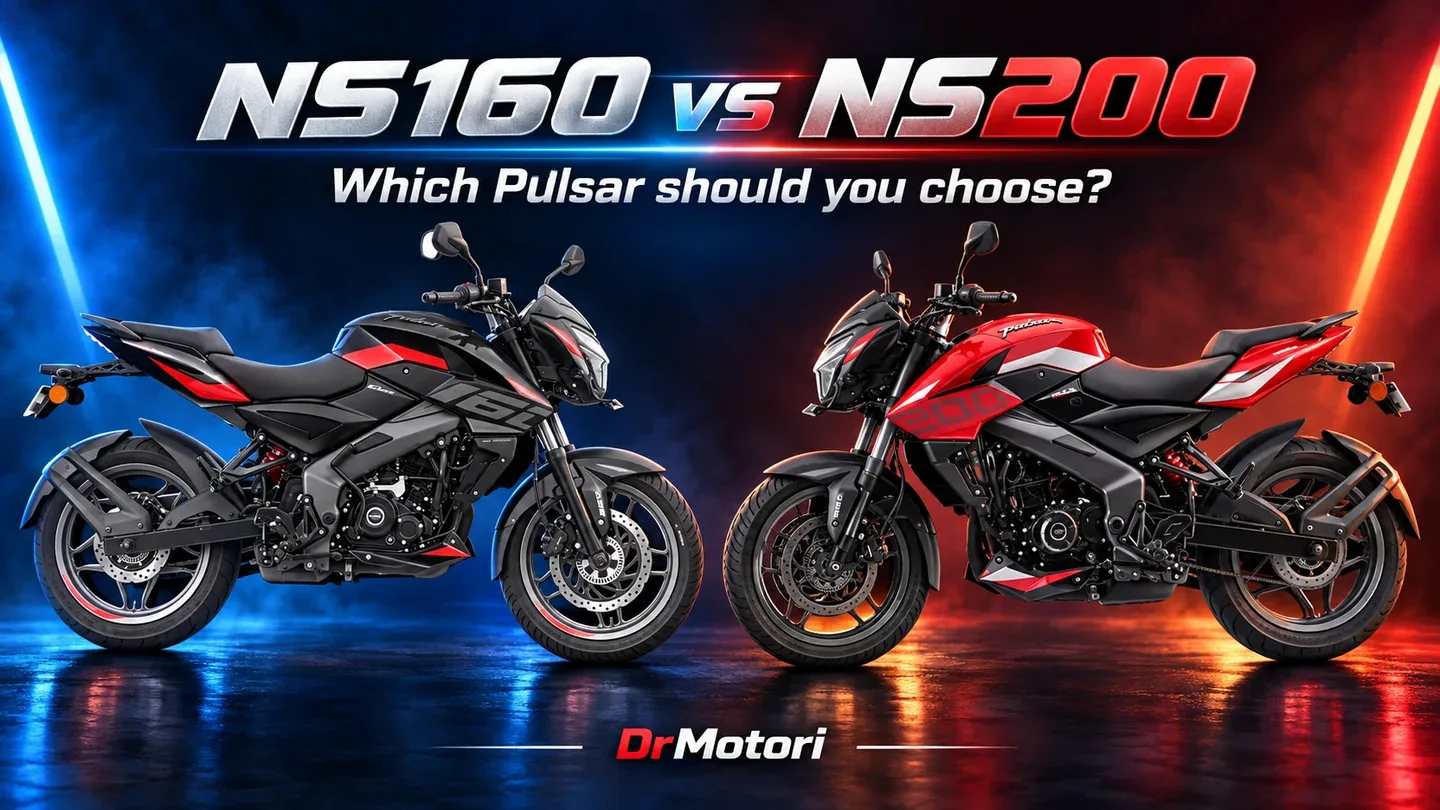
The main trade-off between the Pulsar NS160 and NS200 is straightforward: the NS200 has more claimed power, while the NS160 is slightly lighter. If engine performance is your priority, the NS200 deserves a closer look. If most of your riding is a daily commute, first ask what the NS160 would leave you wanting before paying more. When buying used, a well-maintained NS160 can be a better purchase than a neglected NS200.
Which versions are we comparing?
The figures below refer to the current India-market versions described by Bajaj. Our table uses the dual-channel ABS and upside-down-fork variants. A variant is a version with a particular equipment package. These sources do not establish a specific production year, and bikes offered in Iran may have different equipment. The NS160 is also a separate model from the N160.
The differences that matter
Scroll horizontally to see all columns.
| Specification | Pulsar NS160 | Pulsar NS200 |
|---|---|---|
| Displacement | 160.3 cc | 199.5 cc |
| Claimed power | 12.5 kW; 17 PS | 18 kW; 24.5 PS |
| Claimed torque | 14.6 Nm | 18.74 Nm |
| Cooling | Oil-cooled | Liquid-cooled |
| Kerb weight | 152 kg | 158 kg |
| Seat height | 805 mm | 805 mm |
| Fuel tank | 12 litres | 12 litres |
| Brakes, reference variants | Dual-channel ABS; 300 mm front and 230 mm rear discs | Dual-channel ABS; 300 mm front and 230 mm rear discs |
| Front suspension, reference variants | 37 mm upside-down fork | 37 mm upside-down fork |
What does the NS200’s extra power mean for your choice?
Kilowatts and PS are units of engine power. The NS200’s claimed output is higher, giving it the advantage on paper if you want a more powerful Pulsar. Its torque figure—the engine’s turning force—is higher too. Neither number tells us an acceleration time or guarantees an overtaking result: rider weight, gearing, mechanical condition and road conditions also matter.
Ask whether extra power is something you actually want, or whether the larger model number is doing the selling. If your current bike feels short of performance on your usual route, trying the NS200 is worthwhile. If most of your riding is in traffic, weigh ease of handling and the price of the particular bike alongside its power.
For commuting, weight is only part of the picture
The stated weight difference is 6 kg in the NS160’s favour. That does not prove it will be easier for every rider to handle. Both have the same brochure seat height, but seat width and riding position also affect how securely you can reach the ground.
Sit on both bikes wearing your usual riding footwear. Check your footing, reach to the handlebars and how manageable the bike feels when moving it with the engine off in a parking space. If you regularly carry a passenger, check their seating space as well. A specifications table cannot replace this simple fit check.
Oil or liquid cooling: what should you check?
The NS160 uses oil to help remove engine heat. The NS200 has a coolant circuit and radiator. On a used NS200, inspect that system as well as the engine: leaks, radiator and hose condition, and proper cooling-system operation all deserve attention.
The extra hardware is not evidence that the NS200 is more likely to fail. Nor does oil cooling make the NS160 maintenance-free. To compare running costs, ask for service and parts prices for the exact year and variant of each bike. Without those quotes, there is no sound basis for declaring one definitively cheaper to maintain.
ABS and equipment: the model name is not enough
ABS helps prevent wheel lock during braking. Dual-channel ABS provides that control at both wheels. The reference variants in Bajaj’s brochure have dual-channel ABS and matching disc sizes, but that does not establish identical stopping distances. Tyre condition, brake pads and the road surface also matter.
The brochure lists conventional forks on some variants and upside-down forks on the DC USD variants. Phone connectivity, navigation and USB charging also differ between its columns. There is a headlamp discrepancy for the NS160: the specifications page lists halogen, while the brochure and product page show LED. Match the equipment to the actual bike and its paperwork rather than relying on the advertisement alone.
Four checks before you pay
- Compare bikes of similar age and condition. An advertised asking price is not a confirmed transaction price.
- Keep the purchase price separate from initial running costs. A first service, tyres, chain and sprockets, or brake pads may be needed.
- Assess the displayed mileage alongside condition and service history. Have a qualified person inspect the engine, frame, brakes and paperwork.
- Do not infer fuel economy from engine size. We do not have comparable Iran-market fuel-consumption data for this article.
So, should you buy the NS160 or NS200?
If extra power is your main reason for buying and the particular bike’s purchase and maintenance costs fit your budget, the NS200 is the more defensible choice. If your priority is commuting and the NS160 meets your needs when you try it, a larger engine alone is not a reason to move up.
For a used purchase, condition can reverse that decision. A mechanically sound NS160 with clear paperwork and a good service history can matter more than the NS200’s higher specifications. Compare two actual bikes, not just two model names.
Take a closer look at both Pulsars
Open our Pulsar NS160 model page and Pulsar NS200 model page. These are global catalogue records based on India-market sources. Match the year and equipment separately when considering a bike for sale in Iran.
Take both Pulsars into the garage
Once you have compared the specifications, select both models in the DrMotori Garage and try the game. This virtual test drive is an entertainment simulation. Its appearance and behaviour are not evidence of a real motorcycle’s acceleration, braking or ride quality.
Is the Pulsar NS160 the same as the N160?
No. They are separate models. This comparison concerns the NS160; check the exact name in the advertisement and paperwork.
Do all NS160s and NS200s have dual-channel ABS?
Current India-market equipment does not establish what every year or market received. Check the ABS system and fork type on the bike you are considering.
Which is better as a first motorcycle?
Engine size alone cannot answer that. Your control of the bike, riding-position fit, budget and its condition matter. The NS160 has a lower stated weight, but that does not make it the better choice for every beginner.
Sources and review date
Sources checked on 14 October 2026. The table uses the specifications page of the official NS-family brochure, plus Bajaj’s NS160 specifications and NS200 specifications. The headlamp discrepancy was also checked against the NS160 product page. The buying guidance is an analysis of those specifications, not a road-test report.