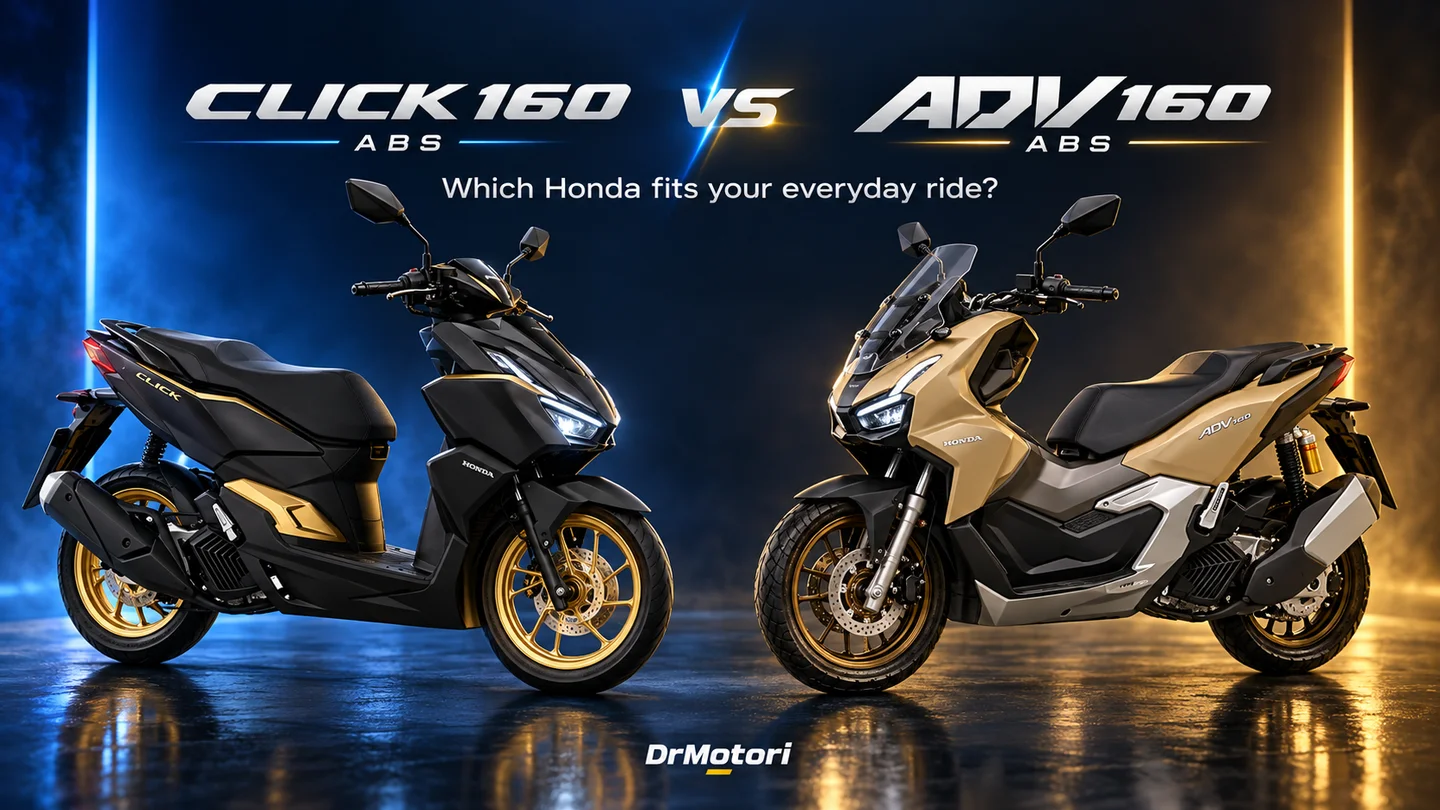
Which suits your daily use?
If you prefer not to change gears yourself during your commute, consider an automatic scooter. If you enjoy selecting gears, a manual-clutch motorcycle may suit your preferences.
For work and carrying items, the answer depends on the particular model: check luggage space, load limits, service costs and parts availability. Transmission type alone does not decide the winner.
The main difference: who changes gear?
On a manual-clutch motorcycle, gear changes involve the handlebar clutch lever and a gear pedal. The clutch temporarily disconnects engine power from the wheel.
On a typical automatic scooter, these actions are unnecessary while riding. Its transmission is usually a CVT, which continuously varies the transmission ratio rather than requiring you to select gears with a pedal.
This article compares typical automatic scooters with manual-clutch motorcycles. Scooter describes a motorcycle style; scooters across all model years do not share one identical transmission.
Differences in everyday use
Scroll horizontally to see all columns.
| Criterion | Automatic scooter | Manual-clutch motorcycle |
|---|---|---|
| Stop-start traffic | No manual clutch operation or gear changes | You operate the clutch and gears |
| Carrying items | Check the particular model's storage compartments | Check load space and compatible accessories |
| Moving in a parking area | Depends on model weight and dimensions | Depends on model weight and dimensions |
| Maintenance | Engine and transmission servicing required | Engine and transmission servicing required |
For commuting, consider stops and storage
If your route has many traffic lights and stops, avoiding manual clutch operation and gear changes may appeal to you. Then check the storage compartments: do your helmet, bag or daily purchases actually fit?
Under-seat storage varies between scooters. For a manual motorcycle, ask about model-specific top-box or luggage options.
For work, load limits and repair time matter
Read load limits and accessory mounting instructions in the motorcycle's own manual. An item fitting on the motorcycle does not establish that carrying it is permitted.
If you work with the motorcycle every day, ask about consumable parts, service time and mechanics for that model in your city. Repair downtime can reduce working time as well as add repair costs.
If choosing gears is part of your enjoyment
Enjoying gear changes is a reasonable selection criterion. A sporty appearance or manual transmission does not establish acceleration or handling. Compare specific models using evidence for their actual versions.
How can you compare maintenance costs?
Get local quotes for several items on two particular models. Use comparable part quality, quote dates and usage.
Do not compare just one service bill. The manual's service intervals matter too: calculate how often each task is required at your typical mileage.
- Suitable oil, filters, brake pads and tyres for each model.
- Transmission parts: for a CVT scooter, items such as the belt according to the manual; for a chain-driven model, chain and sprockets.
- Labour, parts availability and delivery wait.
- Overdue servicing and repairs on the used example.
Check these before buying
- Exact version: read year and trim from the motorcycle's documents.
- Control at a standstill: with permission, sit on the motorcycle and check control reach and your feet reaching the ground.
- Parking: measure entry width and turning space. Try moving it with the engine off in a safe place.
- Two-person use: inspect the passenger seat, footrests and permitted load.
- Budget: add equipment and initial maintenance to purchase price. A used motorcycle needs a mechanical inspection.
Is a scooter better as a first motorcycle?
If you prefer to avoid a manual clutch and gear changes, an automatic scooter is worth considering. Control, braking and balance still require training and practice. The motorcycle's size and weight must fit you.
Does a scooter always use less fuel?
This cannot be generalized to every scooter. Compare two specific models using matching measurement methods and units. Your route and operating conditions may differ from the conditions used for the published consumption figure.
Sources
The automatic-transmission explanation uses Yamaha's technical reference. The NS200 manual supplies information on manual controls and chain maintenance. Sources were reviewed on 12 Mehr 1405 in the Solar Hijri calendar.