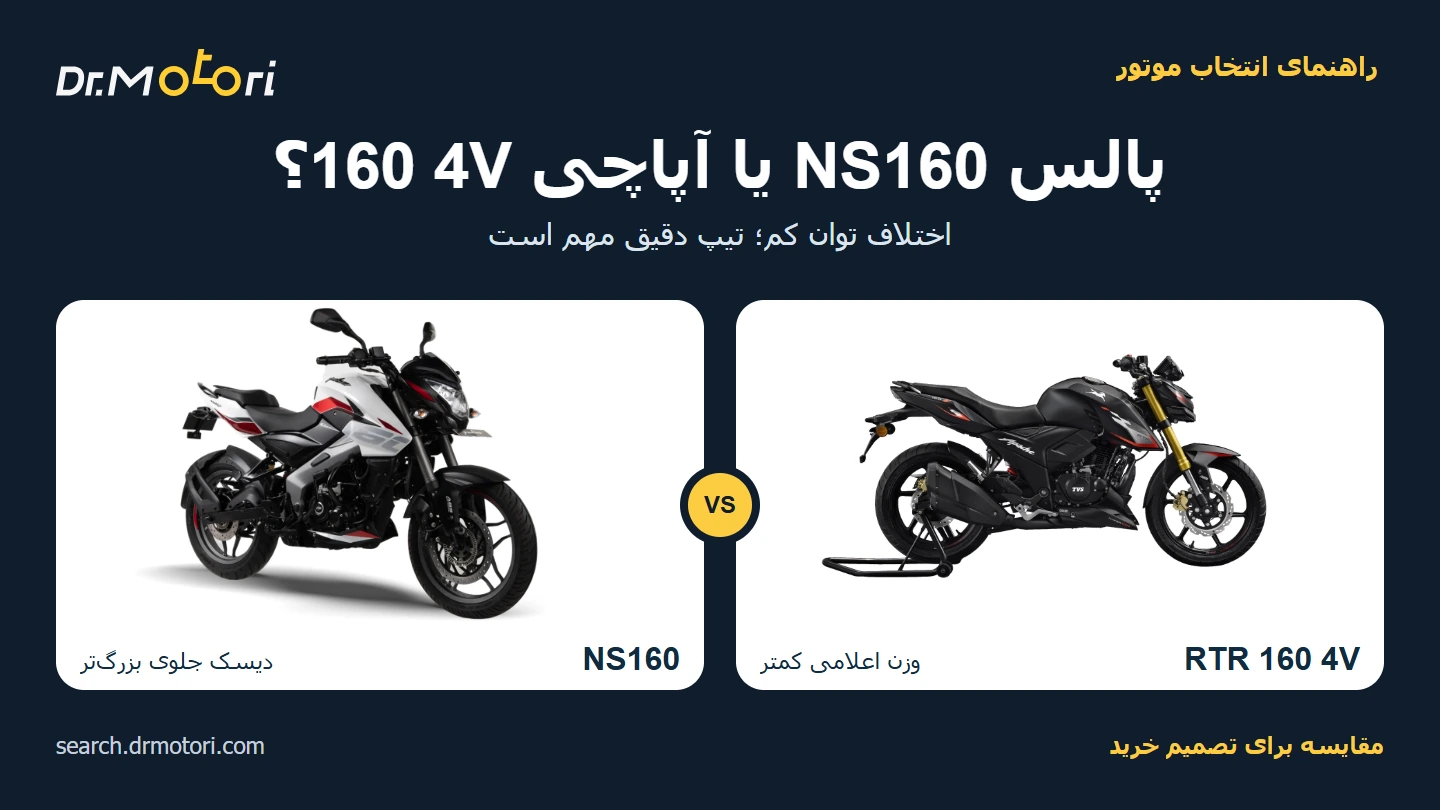
Pulsar NS160 or Apache RTR 160 4V: which fits your priorities?
The Apache RTR 160 4V has a specification advantage if lower quoted weight and selectable engine modes matter most. The Pulsar NS160 offers a larger front disc and the connectivity equipment listed in its reference brochure.
For the selected variants, the Apache produces only 0.41 kW more peak power, a difference of about 3.3%. Exact specification and how the bike fits you can matter more than this small peak-power gap.
This comparison uses India-market references: the NS160 DC USD and the Apache RTR 160 4V with dual-channel ABS and USD forks. An advertisement saying only “Pulsar 160” or “Apache 160” does not establish the same specification.
The differences that can change a buying decision
Scroll horizontally to see all columns.
| Criterion | Pulsar NS160 DC USD | Apache RTR 160 4V, DC ABS with USD |
|---|---|---|
| Peak power | 12.5 kW | 12.91 kW in Sport mode |
| Kerb weight | 152 kg | 146 kg |
| Seat height | 805 mm | 800 mm |
| ABS and front fork | Dual-channel ABS; 37 mm USD | Dual-channel ABS; 37 mm USD |
| Fuel tank and gearbox | 12 litres; five speeds | 12 litres; five speeds |
Specifications and photographs of both models
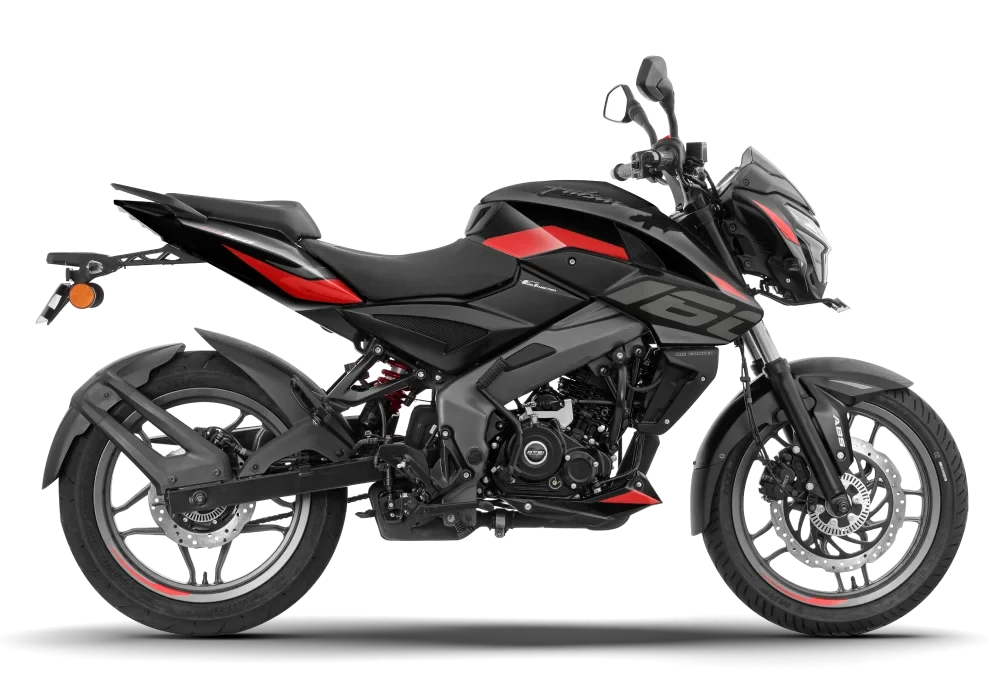
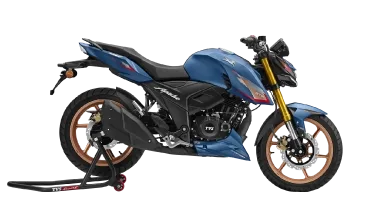
Do not combine the single-channel Apache with the USD version
The selected Apache is the RTR 160 4V with dual-channel ABS and upside-down forks. The single-channel version’s 143 kg figure does not belong to this variant; the Apache reference in this comparison weighs 146 kg.
For the NS160, the DC USD column in Bajaj’s brochure is the reference. A Pulsar with conventional telescopic forks or a different brake specification needs to be assessed against its own variant’s details.
When buying in Iran, record the full model designation, year shown in the documents, fork type and ABS channel count in the seller’s offer. This article’s publication date does not establish the bike’s production year or trim.
Peak output is close, but it arrives at different engine speeds
Scroll horizontally to see all columns.
| Specification | NS160 DC USD | RTR 160 4V, DC ABS with USD |
|---|---|---|
| Engine displacement | 160.3 cc | 159.7 cc |
| Peak power | 12.5 kW at 9,000 rpm | 12.91 kW at 9,250 rpm; Sport |
| Peak torque | 14.6 Nm at 7,250 rpm | 14.73 Nm at 7,500 rpm; Sport |
| Cooling | Oil-cooled | Oil-cooled |
| Gearbox | Five speeds | Five speeds |
The Apache’s 3.3% power advantage is not an acceleration claim
In Sport mode, the Apache’s peak output exceeds the NS160 by 0.41 kW. Dividing that gap by the Pulsar’s 12.5 kW gives about 3.3%; the peak-torque gap is only 0.13 Nm.
For a buyer choosing between these two, peak power alone is a weak reason to pay a premium. The Apache and NS160 reach their quoted peaks at 9,250 and 9,000 rpm respectively; those two points do not describe their behaviour throughout the rev range.
If replacing an NS160 is meant to deliver a noticeable performance change, do not stop at the 12.91 kW figure. Assess throttle response and shifting on the actual bike during a permitted test ride. A power percentage is not an acceleration percentage.
Apache output depends on the selected mode
Scroll horizontally to see all columns.
| RTR 160 4V mode | Peak power | Peak torque |
|---|---|---|
| Sport | 12.91 kW at 9,250 rpm | 14.73 Nm at 7,500 rpm |
| Urban / Rain | 11.50 kW at 8,650 rpm | 14.14 Nm at 7,250 rpm |
Apache engine modes and Pulsar ABS modes are different categories
The Apache’s quoted peak power in Urban and Rain is 11.50 kW. The 12.91 kW figure therefore does not apply to every mode. Keep the selected mode beside the output figure when comparing engine specifications.
Bajaj’s NS160 DC USD brochure also lists ABS ride modes. That description should not be treated as the same engine-output adjustment shown for the Apache. The presence of a “mode” does not identify which system it changes.
When inspecting the Apache, ask the seller to demonstrate the selected mode on that bike’s display. For the Pulsar, check the ABS settings against the correct manual. A shared riding-mode label does not replace this variant-specific check.
Both references have dual-channel ABS, but disc sizes differ
Scroll horizontally to see all columns.
| Equipment | NS160 DC USD | RTR 160 4V, DC ABS with USD |
|---|---|---|
| ABS | Dual-channel | Dual-channel |
| Front disc diameter | 300 mm | 270 mm |
| Rear disc diameter | 230 mm | 240 mm |
| Front fork | 37 mm upside-down | 37 mm upside-down |
Separate the NS160’s larger front disc from braking results
The NS160 has a front disc that is 30 mm larger in diameter; at the rear, the Apache’s disc is 10 mm larger. This identifies a component difference, but does not rank the bikes by stopping distance.
If dual-channel ABS is a purchase requirement, both selected versions meet it. Do not count ABS as an exclusive advantage for either one. Have the braking system on the actual bike assessed during the technical inspection.
A 37 mm upside-down fork is another shared specification. Matching USD labels and fork diameters are not a comfort or bump-absorption test result; they help establish whether the seller is offering the correct version.
The Apache is lighter and has a slightly lower seat
Scroll horizontally to see all columns.
| Published measurement | NS160 DC USD | RTR 160 4V, DC ABS with USD |
|---|---|---|
| Kerb weight | 152 kg | 146 kg |
| Seat height | 805 mm | 800 mm |
| Wheelbase | 1,372 mm | 1,357 mm |
| Ground clearance | 170 mm | 180 mm |
Check the six-kilogram weight difference alongside actual seat fit
The Apache reference is six kilograms lighter than the NS160, with a seat five millimetres lower. If moving an unpowered bike around a parking space is a priority, these figures give you a concrete reason to inspect the Apache first.
Sit on both the NS160 and Apache in your usual footwear and assess your reach to the ground and handlebar. A five-millimetre seat-height difference does not, by itself, establish how the seat suits your leg length.
The Apache also has ten millimetres more ground clearance and a wheelbase fifteen millimetres shorter. Keep these as dimensional differences; they do not establish a decisive advantage in cornering, riding over bumps or carrying a passenger.
Tank capacity and gear count provide no numerical advantage here
The selected NS160 and Apache both have a 12-litre tank, a five-speed gearbox and oil cooling. A larger tank, an extra gear or an air-versus-liquid-cooling distinction is therefore not a basis for choosing between these references.
Equal tank capacities on the Pulsar and Apache do not mean equal distances between fuel stops. If commuting is your main use, assess consumption and refuelling intervals for the exact version and conditions. The 12-litre figure compares tank volume only.
Do not transfer TFT-trim equipment to every RTR 160 4V
The Apache RTR 160 4V family distinguishes DC ABS with USD, TFT and TFT Map versions. TVS’s official page limits the TFT display and traction control to specified trims.
For the dual-channel USD Apache in this article, the 4V designation does not establish a TFT screen, traction control or map display. If those features justify paying more, record the trim and demonstrate their operation on the bike being offered.
For the NS160 DC USD, Bajaj’s brochure lists a digital LCD, turn-by-turn navigation, call and message alerts, and a Type-A USB port. Match that list to the seller’s Pulsar display and the manual for its exact version.
Which one should you inspect first?
Scroll horizontally to see all columns.
| Your priority | Start with | Reason and condition |
|---|---|---|
| Lower quoted weight and a slightly lower seat | Apache RTR 160 4V, DC ABS with USD | 146 kg and an 800 mm seat; assess actual fit on the bike. |
| Selectable engine modes | Apache RTR 160 4V, DC ABS with USD | Sport output differs from Urban/Rain; verify the modes and their operation. |
| A larger front disc | Pulsar NS160 DC USD | 300 mm versus 270 mm compares component size, not a stopping-distance test. |
| Dual-channel ABS, USD forks and five gears | Both selected versions | These are shared; move the decision to fit, condition and the purchase offer. |
What should you compare for purchase and ownership costs?
- Request dated prices for the exact year and trim of the NS160 DC USD and Apache RTR 160 4V with DC ABS and USD. Do not substitute a single-channel Apache for the version in the comparison.
- Obtain the service schedule and itemised consumables prices, including labour, for both bikes. Specify USD or TFT when asking about the Apache, and DC USD when asking about the Pulsar.
- For an installment offer on either bike, request the delivered trim, down payment, total installments, mandatory charges and delivery date in writing. A lower monthly installment alone does not make the same motorcycle cheaper overall.
- For a used NS160 or RTR 160 4V, assess the actual bike’s condition before comparing final prices. A small peak-power difference cannot replace a technical inspection of the motorcycle you would receive.
Is the Apache 160 4V definitely faster than the Pulsar NS160?
A 3.3% peak-power difference does not, on its own, answer an acceleration or speed question. This comparison uses Apache Sport mode and the Pulsar DC USD reference; do not turn the power figure into an acceleration percentage.
Does the Apache 160 4V weigh 143 or 146 kg in this comparison?
The dual-channel ABS version with USD weighs 146 kg. TVS assigns the 143 kg figure to the single-channel version. Combining that lighter figure with the USD equipment list would mix two different variants.
Which should a city commuter inspect first?
If lower quoted weight and a slightly lower seat matter most, start with the dual-channel USD Apache. If the NS160 better fits your body and equipment needs, the 0.41 kW power gap is not enough reason on its own to reject it.
How was this comparison prepared?
This is a document-based analysis of the NS160 and RTR 160 4V, not a road test. Official Bajaj and TVS sources and the DrMotori records were reread on 15 November 2026.
The Pulsar reference is the NS160 DC USD brochure column. The Apache reference is the official page’s variant-specific DC ABS with USD specification. The TFT Map brochure helps define equipment boundaries; its features are not transferred to every Apache version.
The numerical differences were calculated from those source values. Photographs are official catalogue illustrations of the two model families. The DrMotori editorial methodology explains the publishing approach.